TL;DR
The AI Governance Maturity Curve: Why Most Organizations Stall at Level 2
Most organizations are further along in AI adoption than they are in AI governance.
Employees are using generative AI tools. Business applications are adding copilots and automated decision features. Vendors are introducing AI into products that organizations already rely on. In response, many companies have created an AI policy, surveyed departments, or started an inventory.
That is progress, but it is often where progress stops.
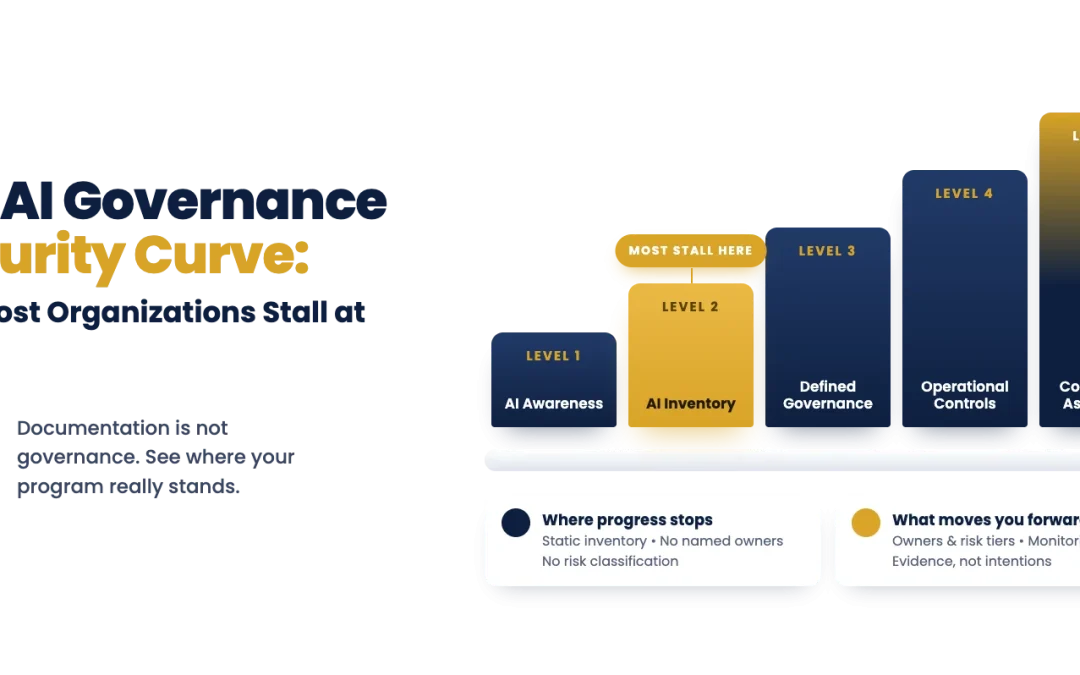
The AI Governance Maturity Curve is a practical way to understand the difference between knowing AI exists and managing it as an ongoing business risk. Most organizations reach Level 2, where AI tools and use cases are documented, but ownership, controls, monitoring, and evidence remain inconsistent.
Moving forward requires more than another policy. It requires a repeatable operating model.
Idril’s 2026 AI Compliance Readiness Guide provides a practical starting point for organizations that want to move from informal AI adoption toward structured, defensible governance.
AI Adoption Has Moved Faster Than Governance
Most organizations did not begin using AI through a coordinated enterprise program.
Adoption happened gradually.
A marketing team began using generative AI to draft campaign copy. Developers added coding assistants to their workflow. Customer service teams used AI to summarize tickets. HR platforms introduced automated screening features. Existing software vendors added copilots, predictive analytics, or recommendation engines.
Over time, AI became part of normal business operations without passing through a single approval process.
This creates a mismatch: the organization may be using AI at scale while governing it informally.
The gap becomes visible when leaders begin asking basic questions:
- Which AI systems are currently in use?
- What data are they processing?
- Who approved them?
- Who is accountable for their outputs?
- How are vendors assessed?
- What evidence would we provide to an auditor or customer?
- How would we respond if an AI system caused harm?
Organizations often discover that they can answer some of these questions, but rarely all of them.
That is the purpose of the AI Governance Maturity Curve: to show where governance currently stands and what must change before it can support responsible AI growth.
The Five Levels of AI Governance Maturity
The curve below is an Idril working model designed to help mid-market organizations assess how AI governance develops over time.
It is informed by recognized guidance such as the NIST AI Risk Management Framework, the NIST AI RMF Playbook, and the ISO/IEC 42001 AI Management System standard.
| Level | Stage | What It Looks Like |
|---|---|---|
| Level 1 | AI Awareness | AI is already being used, but leadership has limited visibility into tools, data, or risk. |
| Level 2 | AI Inventory | AI systems and use cases are being documented, but governance remains largely manual and reactive. |
| Level 3 | Defined Governance | Ownership, policies, risk classifications, and approval processes are established. |
| Level 4 | Operational Controls | Monitoring, vendor oversight, incident response, training, and evidence collection are embedded into daily operations. |
| Level 5 | Continuous Assurance | Governance is measured, reviewed, audited, and improved throughout the AI lifecycle. |
Level 1: AI Awareness
At Level 1, employees and departments are adopting AI independently. The organization may know AI is being used, but it does not have a reliable inventory or clear governance process.
The immediate priority is visibility.
Level 2: AI Inventory
At Level 2, the organization has begun identifying AI tools, vendors, and use cases. It may also have an acceptable-use policy or informal review process.
However, the inventory often remains a static document. Ownership, monitoring, risk classification, and recurring reviews are still inconsistent.
This is where most organizations stall.
Level 3: Defined Governance
At Level 3, governance becomes repeatable.
The organization has clear policies, named owners, risk classifications, approval requirements, and defined responsibilities across security, privacy, legal, compliance, procurement, and business teams.
Level 4: Operational Controls
At Level 4, governance is built into everyday operations.
AI systems are monitored, vendors are reassessed, employees are trained, incidents can be reported, and higher-risk use cases receive stronger human oversight and control.
Level 5: Continuous Assurance
At Level 5, the organization regularly tests and improves its governance program.
AI inventories, controls, vendor risks, incidents, and performance indicators are reviewed through an established reporting and assurance process.
How Do You Know Which Level You Are At?
Your maturity level should be based on evidence, not intention.
A useful test is to ask whether the organization can produce the following:
- A current AI inventory
- Named owners for material AI systems
- Risk classifications
- Vendor assessments
- Data-flow documentation
- Approval records
- Human-oversight requirements
- Monitoring results
- Incident procedures
- Employee training records
- Executive reporting
- Reassessment schedules
An organization may have a policy that describes all of these activities. If the evidence does not exist, the activity may not yet be operational.
That distinction is what separates Level 2 from Levels 3 and 4.
AI Governance Maturity Is a Business Capability
The purpose of AI governance is not to slow adoption.
It is to help organizations adopt AI with enough visibility, accountability, and control to scale responsibly.
Organizations that remain at Level 2 often experience the same cycle:
- AI use grows.
- A policy is created.
- An inventory is assembled.
- Business adoption continues.
- The inventory becomes outdated.
- A customer, auditor, executive, or incident exposes the gap.
Moving beyond this cycle requires governance to become part of how the business evaluates vendors, approves use cases, handles data, monitors performance, and responds to change.
The strongest programs connect governance to business decisions rather than treating it as a separate compliance exercise.
Download the 2026 AI Compliance Readiness Guide
Knowing your current maturity level is only the beginning.
The next step is turning that insight into a practical plan.
Idril’s 2026 AI Compliance Readiness Guide includes resources designed to help mid-market organizations move from informal AI use toward structured governance, including:
- An AI compliance readiness scorecard
- AI inventory guidance
- Regulation comparisons
- Questions leadership should be prepared to answer
- Worked AI governance examples
- A 90-day implementation roadmap
- Evidence artifacts for each phase
Download the 2026 AI Compliance Readiness Guide and identify the next practical step for your organization’s AI governance program.
Organizations that need support evaluating their current position can also review Idril’s Cybersecurity as a Service offering or start with the company’s free Cyber Risk Assessment process.
Ready to Understand Your AI Risk Exposure?
If your organization is already using AI, the question is no longer whether governance is necessary. The question is whether you have enough visibility to manage risk effectively. At Idril Security Services, we help organizations assess AI risks, establish governance frameworks, and build practical compliance programs aligned with emerging standards and regulatory expectations.
Download the AI Compliance Readiness Guide or explore Idril’s Cybersecurity as a Service offering to see how AI governance fits into a broader security strategy.
Frequently Asked Questions
What is AI governance maturity?
AI governance maturity describes how consistently an organization manages AI across policy, ownership, risk assessment, vendor oversight, monitoring, evidence, and continuous improvement. A mature program operates through repeatable processes rather than isolated documents or one-time reviews.
What are the five levels of the AI Governance Maturity Curve?
The Idril working model includes AI Awareness, AI Inventory, Defined Governance, Operational Controls, and Continuous Assurance. The levels show how organizations progress from limited visibility to repeatable and measurable governance.
Why do organizations stall at Level 2?
Most stall because they treat AI governance as a documentation exercise. They create an inventory or policy without assigning ownership, classifying risk, defining approval processes, monitoring systems, or establishing a recurring review cadence.
Is an AI inventory enough for compliance?
An inventory is a foundational requirement, but it does not demonstrate complete governance. Organizations also need ownership, risk assessments, controls, monitoring, approval records, vendor reviews, and evidence that governance processes are operating.
How does NIST AI RMF relate to AI governance maturity?
The NIST AI Risk Management Framework organizes AI risk management around Govern, Map, Measure, and Manage. These functions support the transition from informal awareness toward continuous and operational risk management.
How does ISO 42001 relate to AI governance maturity?
ISO/IEC 42001 provides requirements for establishing and continually improving an AI management system. It is especially relevant for organizations moving from isolated governance activities toward a coordinated management framework.
How often should an AI inventory be reviewed?
A quarterly review is a practical minimum for many organizations. Reviews should also be triggered when new tools are adopted, vendors introduce AI features, data use changes, or an existing AI system expands into a new business process.
Who should own AI governance?
AI governance usually requires participation from security, legal, privacy, compliance, procurement, IT, and business leaders. The program needs an accountable executive sponsor, while each material AI use case should have a named business owner.
Can mid-market organizations build mature AI governance without a large internal team?
Yes. Mid-market organizations can build effective governance by prioritizing higher-risk use cases, adapting existing security and compliance processes, and using fractional leadership or advisory support where internal expertise is limited.
What is the first step for moving beyond Level 2?
Begin by assigning owners to material AI systems and classifying each use case by risk. Those two steps turn the inventory into a decision-making tool and create the foundation for approvals, controls, monitoring, and reassessment.