The Enterprise Buyer’s Guide to AI Vendor Risk: A Practical Framework for Evaluating AI Vendors Before You Sign
Artificial intelligence is transforming the way organizations operate, but it is also changing the way organizations buy software.
Unlike traditional SaaS platforms, AI systems introduce new risks around data privacy, model behavior, governance, explainability, and regulatory compliance. A standard security questionnaire is no longer enough to determine whether an AI vendor is suitable for your organization.
This guide provides a practical framework for evaluating AI vendors before procurement. You’ll learn the five categories of AI vendor risk, a 10-step evaluation process, the questions every procurement team should ask, and how AI vendor assessments support broader AI governance initiatives.
Whether you’re evaluating an AI copilot, an enterprise chatbot, or an AI-powered SaaS platform, a structured assessment can help reduce risk before contracts are signed.
Why Traditional Vendor Reviews Are No Longer Enough
For years, enterprise procurement followed a familiar process.
Security teams reviewed SOC 2 reports. Procurement negotiated contracts. Legal reviewed privacy clauses. IT confirmed integrations. Once the paperwork was complete, implementation began.
AI has fundamentally changed that process.
Unlike traditional software, AI systems generate dynamic outputs, evolve over time, and often rely on multiple underlying models or cloud providers. Many AI vendors also depend on foundation models developed by companies such as OpenAI, Anthropic, Google, or Microsoft, creating an additional layer of third-party risk that traditional vendor reviews rarely consider.
| Traditional Software | AI Systems |
|---|---|
| Predictable outputs | Dynamic outputs |
| Fixed business rules | Model-driven reasoning |
| Static functionality | Continuous model updates |
| Traditional security review | Ongoing governance and monitoring |
| Vendor owns most technology | Vendor may rely on multiple AI providers |
Buying AI is no longer just a procurement decision. It is a governance decision.
Organizations that treat AI like any other software risk overlooking issues that may not become visible until months after deployment.
What Is AI Vendor Risk?
Unlike traditional third-party risk assessments, AI vendor evaluations must consider questions such as:
- What happens to our data?
- Is customer information used to train models?
- Can AI outputs be explained?
- How are hallucinations managed?
- What happens when foundation models change?
- Who is responsible if AI produces harmful recommendations?
These questions extend beyond cybersecurity.
They influence regulatory compliance, operational resilience, customer trust, and enterprise risk management.
Organizations building AI governance programs should evaluate vendor risk as part of a broader governance strategy. Idril’s 2026 AI Compliance Readiness Guide provides additional guidance on establishing governance foundations before AI adoption scales.
The Five Categories of AI Vendor Risk
A structured AI vendor assessment should examine five core risk categories.
1. Data Risk
Data remains one of the most important considerations during AI procurement.
Key questions include:
- What information does the AI process?
- Is customer data retained?
- Is data used for model training?
- Where is data stored?
- Who owns submitted prompts and outputs?
- Can data be deleted upon request?
Organizations handling regulated or sensitive information should require clear documentation on data governance before deployment.
2. Model Risk
Unlike conventional software, AI models may produce inaccurate or unpredictable outputs.
Procurement teams should understand:
- Model accuracy
- Hallucination management
- Explainability
- Bias mitigation
- Human review requirements
- Performance monitoring
No AI model is perfect.
The objective is understanding how vendors identify, monitor, and reduce model-related risks.
3. Operational Risk
AI systems should be evaluated like any critical business service.
Questions include:
- What uptime commitments exist?
- How are incidents communicated?
- How frequently are models updated?
- How are breaking changes managed?
- What disaster recovery processes exist?
Operational resilience becomes increasingly important as AI supports customer-facing and business-critical functions.
4. Compliance Risk
Organizations should determine whether vendors align with recognized governance frameworks.
Examples include:
- ISO 42001
- NIST AI Risk Management Framework
- GDPR
- HIPAA
- SOC 2
- ISO 27001
Framework alignment demonstrates maturity but should never replace a thorough vendor assessment.
5. Third-Party Risk
Many AI vendors do not build their own foundation models.
Instead, they rely on services such as:
- OpenAI
- Anthropic
- Azure OpenAI Service
- AWS Bedrock
- Google Vertex AI
Procurement teams should understand these upstream dependencies because they directly affect availability, security, privacy, and compliance.
A 10-Step AI Vendor Evaluation Framework
The following framework provides a practical approach for evaluating AI vendors before procurement.
Define the Business Use Case
Understand why the organization needs AI and what business problem it solves.
Classify the AI System
Determine whether the solution supports:
- Internal productivity
- Customer interactions
- Decision support
- Business automation
- High-risk processes
Higher-risk use cases require stronger governance.
Map Data Flows
Document:
- What data enters the system
- Where data is stored
- Who can access it
- How long it is retained
Assess Privacy
Review:
- Data retention
- Customer ownership
- Cross-border transfers
- Privacy controls
- Regulatory obligations
Review Governance
Determine whether the vendor has:
- AI governance policies
- Responsible AI principles
- Internal review boards
- Risk management processes
Evaluate Model Transparency
Ask vendors:
- Which models are used?
- How are updates communicated?
- Can outputs be explained?
- Are confidence levels available?
Review Contracts and SLAs
Contracts should clearly address:
- Liability
- Service availability
- Security responsibilities
- Data ownership
- Incident notification
Validate Security Controls
Review:
- SOC 2
- Pen testing
- Encryption
- Identity management
- Access controls
- Vulnerability management
Establish Internal Ownership
Every AI deployment should have:
- Business owner
- Security owner
- Compliance owner
Governance begins with accountability.
Approve, Monitor, and Reassess
Vendor assessments should continue after procurement.
Organizations should perform regular reviews following:
- Major AI updates
- New features
- Regulatory changes
- Contract renewals
- Expanded business use cases
25 Questions Every Procurement Team Should Ask
Governance
- Who owns your AI governance program?
- Do you follow responsible AI principles?
- How are AI risks reviewed?
- Do you have an AI ethics committee?
- How often are governance policies updated?
Security
- Is customer data encrypted?
- How are access controls managed?
- Do you undergo independent security testing?
- Do you maintain SOC 2 certification?
- How are incidents reported?
Privacy
- Is customer data retained?
- Is customer data used to train models?
- Can customers opt out?
- How are prompts handled?
- Where is data stored?
Operations
- How are AI models updated?
- What is your uptime commitment?
- What happens during outages?
- How do you monitor AI performance?
- What business continuity plans exist?
Compliance
- Do you align with ISO 42001?
- How do you support customer audits?
- Which regulatory frameworks do you support?
- Can you provide compliance documentation?
- How frequently are assessments performed?
Common AI Procurement Mistakes
Many organizations make similar mistakes during AI procurement.
These include:
- ❌ Buying AI before governance is established.
- ❌ Assuming SOC 2 automatically covers AI-specific risks.
- ❌ Ignoring prompt retention policies.
- ❌ Failing to identify a business owner.
- ❌ Never reassessing vendors after deployment.
- ❌ Assuming the vendor owns the underlying AI models.
Avoiding these mistakes significantly improves long-term governance.
What an AI Vendor Scorecard Looks Like
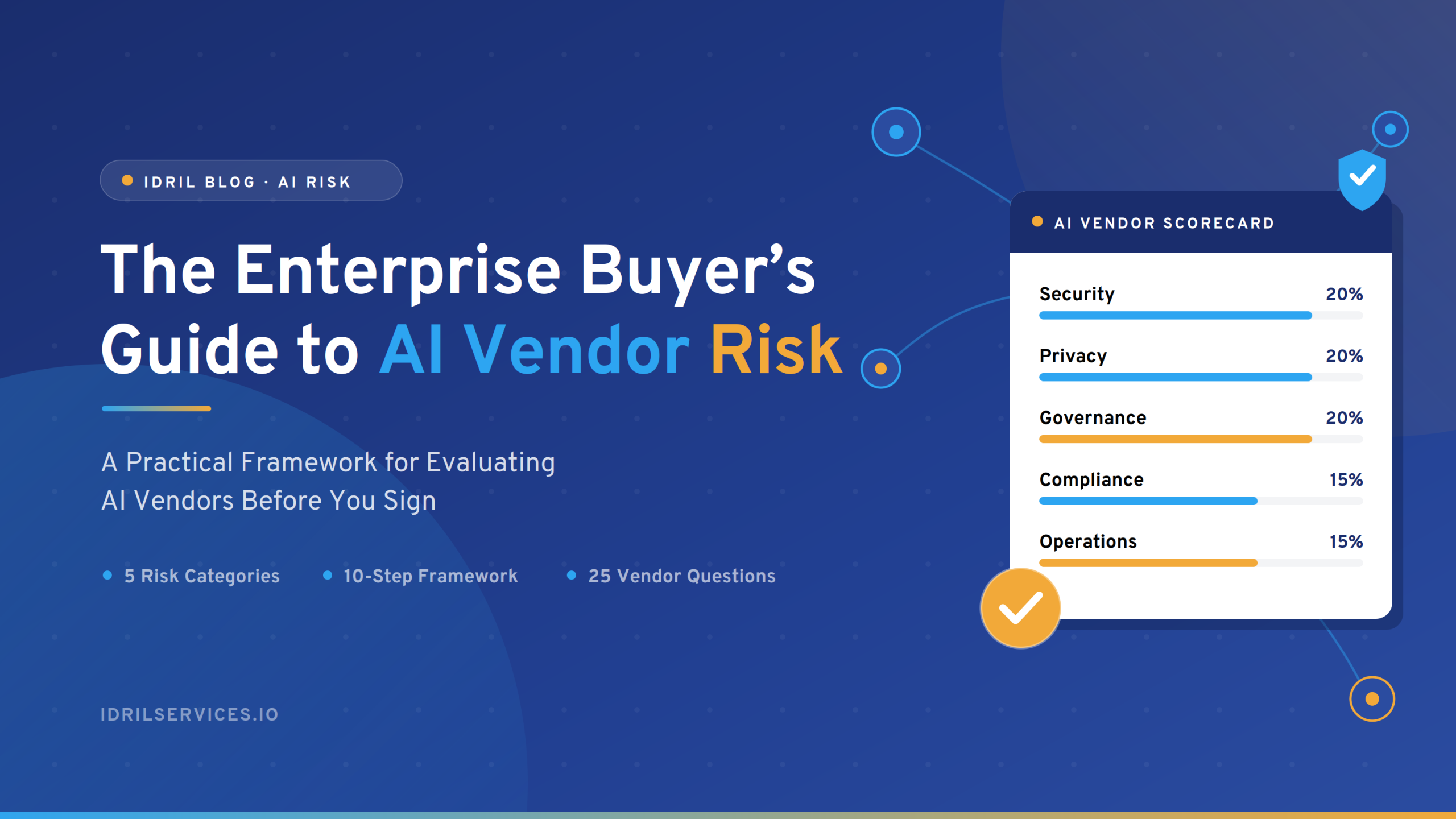
| Category | Weight |
|---|---|
| Security | 20% |
| Privacy | 20% |
| Governance | 20% |
| Compliance | 15% |
| Operations | 15% |
| Vendor Transparency | 10% |
Organizations may choose to assign scores to each category and establish minimum approval thresholds before procurement proceeds.
A structured scorecard creates consistency across procurement decisions and simplifies executive approval.
How AI Vendor Risk Fits Into ISO 42001
ISO 42001 encourages organizations to identify AI risks, manage suppliers, establish governance processes, and continuously monitor AI systems throughout their lifecycle.
Vendor risk assessments support:
- Supplier management
- AI governance
- Risk assessments
- Continuous monitoring
- Compliance documentation
Organizations looking to mature their governance practices can integrate vendor reviews into broader AI compliance initiatives supported by Idril’s Cybersecurity as a Service offering.
When Should You Perform an AI Vendor Risk Assessment?
AI vendor assessments should be performed:
- Before signing a contract
- Before sharing sensitive information
- Before expanding AI use cases
- During contract renewals
- Following significant vendor updates
- After major regulatory changes
Vendor risk is continuous. Assessment should be continuous as well.
AI Vendor Evaluation Checklist
Before approving an AI vendor, confirm that you have:
- ✔ Completed an AI inventory
- ✔ Reviewed data handling practices
- ✔ Evaluated privacy controls
- ✔ Assessed model risks
- ✔ Validated security controls
- ✔ Reviewed compliance documentation
- ✔ Identified business ownership
- ✔ Established monitoring procedures
- ✔ Documented approval decisions
- ✔ Planned future reassessments
Frequently Asked Questions
What is AI vendor risk?
AI vendor risk refers to the operational, security, governance, compliance, and privacy risks associated with third-party AI systems.
How is AI vendor risk different from traditional third-party risk?
Traditional vendor reviews focus primarily on cybersecurity and contracts. AI vendor assessments also evaluate model behavior, governance, explainability, data usage, and ongoing monitoring.
What should be included in an AI procurement checklist?
An effective checklist should evaluate governance, security, privacy, model risk, compliance, operational resilience, contracts, and ownership.
Does SOC 2 mean an AI vendor is trustworthy?
No. SOC 2 evaluates security controls but does not assess AI-specific governance, model risk, or responsible AI practices.
How does ISO 42001 relate to AI procurement?
ISO 42001 provides a management framework for governing AI systems throughout their lifecycle, including supplier management and risk assessments.
What evidence should AI vendors provide?
Organizations should request security reports, compliance certifications, governance documentation, privacy policies, penetration testing summaries, and AI governance policies.
How often should AI vendors be reassessed?
At least annually, and whenever major AI updates, regulatory changes, or business use cases change.
Should procurement involve security early?
Yes. Procurement, security, compliance, legal, and business stakeholders should all participate in AI purchasing decisions.
How do you evaluate generative AI vendors?
Organizations should evaluate governance, privacy, security, model transparency, operational resilience, regulatory alignment, and ongoing monitoring—not just product functionality.
Build Trust Before You Buy
Choosing an AI vendor is about more than features, pricing, or implementation timelines.
Enterprise buyers must understand how AI systems handle data, manage risk, support compliance, and evolve over time.
A structured AI vendor assessment helps organizations select technology they can trust, govern, and scale responsibly.
If your organization is preparing to procure AI solutions, start by downloading Idril’s 2026 AI Compliance Readiness Guide to better understand today’s AI governance landscape.
Need help evaluating vendors or strengthening your AI governance program?
Book an AI + Cyber Risk Assessment with Idril Security Services and gain practical guidance tailored to your organization’s procurement, compliance, and security objectives.
Book Your Free Consultation Call